

The Emerging Competitive Advantage
Every leadership team talks about alignment. Most assume they have it.
A strategy has been approved by management. The board is supportive. The communications plan is complete. Government affairs has a roadmap. Community relations is engaged. The transformation team has a timeline.
On paper, everything appears connected. But the plan gets stuck, slows down, derails.
Employees resist change. Regulators raise new questions. Community opposition emerges. Investors become skeptical. Elected officials who once appeared supportive begin creating distance.
At that point, many organizations conclude they have an execution problem. Or a people problem. More often, they have an alignment problem.
Different stakeholder groups are operating from different understandings of where the organization is going, why it is going there, what tradeoffs are involved, and what success ultimately looks like. The strategy itself may be sound. The challenge is that stakeholders are not aligned around it.
This pattern plays out across major infrastructure projects, public policy initiatives, mergers, acquisitions and integrations, organizational transformations, and highly regulated industries. Organizations rarely struggle because they lack intelligence, resources, or ambition. They struggle because key stakeholders are moving at different speeds, with different expectations, and sometimes toward entirely different outcomes.
In today’s environment, that gap is becoming increasingly expensive.
Research on strategy execution consistently finds that organizations lose between 5% and 10% of annual revenue when priorities, resources, and execution drift out of alignment. Some studies estimate that as much as 40% of potential productivity is lost when strategy and execution become disconnected.
Those losses rarely appear on a financial statement labeled “misalignment.” Instead, they emerge as delayed decisions, duplicated effort, workforce turnover, project overruns, regulatory delays, stakeholder resistance, and opportunities that never fully materialize.
Leaders often describe this as complexity. More often, it is actually friction. And friction is one of the most expensive and least visible costs inside any organization.
As Ben Horowitz observed, “The hard thing isn’t setting a big, hairy, audacious goal. The hard thing is aligning the organization to achieve it.” In other words, strategy creates potential, alignment determines whether that potential is realized.
The challenge for leadership teams is no longer deciding what to do. It is creating enough internal and external alignment that stakeholders are willing to move forward together. Increasingly, that is where competitive advantage is won or lost.
Trust Is the Outcome of Alignment
Consider the growing debate around AI infrastructure and data centers.
Most conversations focus on power consumption, water usage, land development, tax incentives, grid reliability, and economic impact. Those concerns are critical, legitimate, but they are rarely the entire story.
Beneath the surface lies a more fundamental question: Can stakeholders trust the people making the decisions?
Communities want to understand who benefits, what the long-term impact will be, and whether commitments made today will still matter five or ten years from now. They want to know whether an organization understands the community, intends to be a long-term partner, and can be relied upon when challenges inevitably emerge.
When organizations fail to answer those questions early, technical debates quickly become trust debates.
Gordon Locke, Co-Founder & Partner, VantageRoad Partners, said, “The organizations that succeed are rarely those with the most polished messaging. They are the ones that establish credibility before conflict emerges. They engage stakeholders early, create transparency around decisions, and connect business objectives to stakeholder outcomes.”
Trust is not the starting point. Trust is the result of alignment. Misalignment creates resistance. Resistance creates delay. Delay increases costs and erodes confidence.
Trust is often the most visible symptom. Alignment is frequently the underlying cause.
The Hidden Cost of Friction
Organizations often underestimate the economic consequences of stakeholder friction.
The utility sector offers a timely example.
Recently, Fitch revised its outlook for U.S. utilities from neutral to deteriorating, despite AI, electrification and advanced manufacturing driving unprecedented demand. Why? Fitch highlighted increased risk to utility cost recovery citing affordability concerns, increasing political pressure, and growing regulatory scrutiny.
Investors see growth opportunities. Utilities see long-term infrastructure needs. Technology companies see urgency. Regulators see reliability and affordability risks. Communities see rising utility bills. Elected officials see increasingly frustrated constituents.
Everyone is looking at the same facts. Not everyone is drawing the same conclusions. Recent actions by the Federal Energy Regulatory Commission reflect this reality. Regulators have emphasized that growth must be balanced with affordability, reliability, and the interests of existing customers.
In reality, growth from data centers and large load projects does create value. It happens through tax revenue, economic development, infrastructure investment, long-term growth and sometimes through job creation. It happens because all of that reinvestment attracts businesses to the region that scale and create high paying jobs. And yet, the narrative around data centers is stuck.
The real question is whether stakeholders believe they will share in that value. When they do not, alignment erodes. Political pressure increases. Regulatory scrutiny intensifies. Infrastructure deployment slows. Capital costs rise. What begins as an affordability issue often becomes a trust issue. And trust issues have a way of becoming balance-sheet issues.
Fitch recognized these facts saying “Strong data center demand remains a structural positive for the sector and could help utilities spread fixed costs across a larger customer base, benefiting residential customers.
The Deeper Risk of Operating in Silos
Most organizations still approach stakeholder challenges through functional silos. The same is true of major transformations.
Whether the objective is deploying AI infrastructure, modernizing the grid, reshoring manufacturing, executing a merger, transforming a workforce, or launching a new business model, success rarely depends on a single decision or stakeholder group. It depends on an ecosystem.
Employees, customers, regulators, investors, suppliers, policymakers, community leaders, and partners each influence the outcome. They bring different priorities, incentives, concerns, and definitions of success. Progress occurs when those groups develop a shared understanding of where they are headed, why it matters, and how value will be created and shared. When that alignment exists, momentum builds. When it does not, friction emerges.
Organizations often experience that friction as separate challenges: workforce resistance, community opposition, political scrutiny, regulatory delays, stakeholder skepticism, or execution risk.
More often than not, they are symptoms of the same underlying condition. The system is no longer moving in the same direction. Each function may perform exceptionally well, but stakeholders do not experience organizations in silos. They experience them as systems.
A permitting issue becomes a community issue. A community issue becomes a political issue. Political pressure attracts regulatory scrutiny. Regulatory delays increase costs and undermine confidence among investors, customers, employees, and partners.
This is where many organizations get stuck. They focus on solving the problem immediately in front of them rather than examining whether the broader system is aligned around the outcome they are trying to achieve.
The organizations that move fastest understand the difference. Instead of asking, “How do we solve this problem?” They ask, “How do we align the system around the outcome we need?” That shift changes everything.
Alignment Does Not Require Agreement
One of the most common misconceptions about trust and alignment is that everyone must agree. They do not. In fact, they rarely will.
People can disagree with a decision and still support moving forward if they believe the process was fair, the rationale was clear, and their perspective was genuinely considered.
The opposite is also true. People frequently oppose initiatives that may ultimately benefit them when they feel surprised, excluded, or dismissed.
Trust is not built through consensus.
It is built through consistency. When words match actions. When decisions follow clear principles. When stakeholders understand how and why decisions are being made. When organizations do what they say they will do, especially when circumstances become difficult.
Rachel Botsman famously described trust as “a confident relationship with the unknown.” That definition helps explain why alignment matters.
Organizations rarely fail because they lack plans. They fail because too many people are operating from different assumptions about the plan.
See content credentials
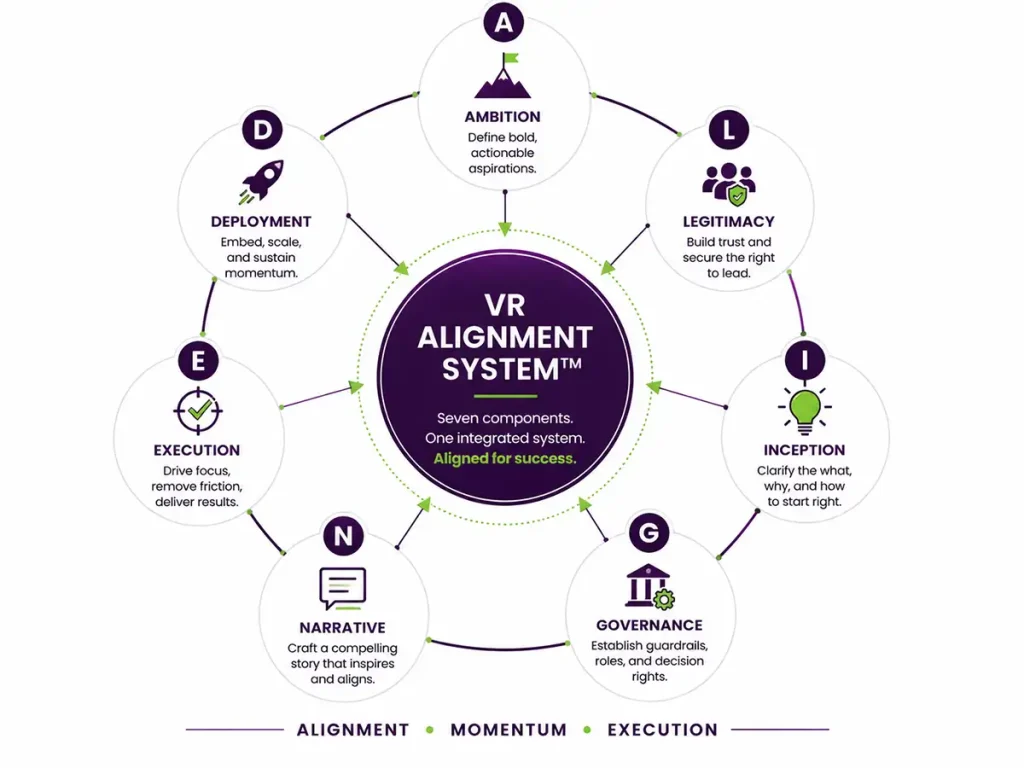
Alignment and Permission to Grow are linked and the tools and micro steps across the alignment continuum are complex. VantageRoad Partners © 2026
So What, Now What?
Food for Thought: Five Ways of Building Alignment as a Leadership Discipline
The organizations that navigate complexity most effectively will approach alignment as a leadership discipline.
- The Importance of Creating a Shared Definition of Success
Before launching a major initiative, leaders should ask:
What does success actually look like? How will different stakeholders define success? Where do those definitions align? Where do they conflict?
Alignment begins when stakeholders understand not only where the organization is going, but how value will be created and shared and how they can effectively contribute to it.
- Putting Alignment of the Internal Reality Before External Messaging
Organizations often communicate externally before they have achieved internal alignment.
Employees hear one message. Customers hear another. Investors hear a third. Regulators hear something entirely different. Stakeholders quickly recognize inconsistency.
The strongest organizations ensure leadership teams, business units, communications functions, policy teams, and operational leaders are aligned before engaging externally.
Trust is difficult to build when organizations are sending conflicting signals.
- They Choose to Engage Early, Not After Decisions Are Made
Many stakeholder processes are designed around informing people of decisions. Alignment requires involving them in understanding the challenge. Stakeholders are more likely to support difficult decisions when they understand:
Why change is necessary? What tradeoffs are involved? How decisions are being made? What opportunities and risks exist?
People do not need a veto. They need transparency and to be heard.
- They Integrate the Stakeholder by Building Stakeholder Systems, Not Stakeholder Lists
Many organizations manage stakeholders as individual relationships. Leading organizations integrate stakeholder ecosystems. They understand how:
- Communities influence policymakers
- Policymakers influence regulators
- Regulators influence investors
- Investors influence strategy
- Employees influence reputation
The objective is not managing individual stakeholders. It is understanding how the system operates and integrating it into the planning of the organization.
- They Create Mechanisms for Continuous Alignment
Alignment is not a kickoff meeting. It is not a town hall. It is not a communications campaign.
It is an ongoing process. The VR Alignment System is an example of this.
Organizations that sustain momentum create mechanisms that continually test assumptions, surface concerns, and identify emerging friction before it becomes resistance. The goal is not to be perfect. Aim to get in front of small misalignments before they become bigger ones. Before the narrative and opposition calcifies.
- Measure Friction Like Any Other Business Risk
Most organizations measure financial performance, operational performance, and customer performance. Few measure stakeholder friction. Yet friction often predicts future execution risk. Leading indicators might include:
- Regulatory delays
- Community opposition
- Employee sentiment
- Stakeholder trust measures
- Escalating political scrutiny
- Permitting timelines
- Cross-functional decision velocity
The Emerging Competitive Advantage
For decades, leaders defined competitive advantage through capital, technology, talent, and scale. Those factors still matter. But another variable is becoming increasingly important:
The ability to create alignment across employees, customers, communities, policymakers, regulators, investors, and partners.
At the same time, trust in institutions continues to face pressure. Stakeholders expect greater transparency, more engagement, and stronger accountability than they did even a decade ago.
Support can no longer be assumed. It must be earned.
Organizations that treat alignment as a continuous discipline rather than a point-in-time exercise move faster because they reduce friction before it emerges. They create mechanisms that keep leaders, functions, and stakeholders moving toward the same outcome even as conditions change.
They encounter less resistance. They adapt more effectively. They preserve trust through uncertainty and change. Most importantly, they earn something every organization needs but few can assume: Permission to grow.
The organizations that outperform in the next decade will not necessarily have the best strategy.
They will have the greatest capacity to align people around it, coordinate action across increasingly complex stakeholder environments, and convert friction into forward momentum.
Every organization will face resistance. The question is whether that resistance becomes productive tension or costly friction. The difference is alignment. And alignment is what ultimately creates trust, accelerates execution, and earns permission to grow.