



“Ask forgiveness, not permission” is not the counsel we give our kids in their formative years (although arguably mine have adopted it as code at some points). It can be decent, if expensive, advice for “regulatory entrepreneurs” like Airbnb or Uber. They viewed it as a cost of doing business and absorbed that downside to entrench in a market. The collateral damage, companies that were previously moat protected and slow to innovate, like hotels and taxis, was outweighed by the convenience and adoption factor. And inside a company, with a reversible decision, moving first and fast often teaches you more than another meeting would.
There is downside in that strategy. Moving fast and breaking things starts being a liability the moment the downside lands on somebody else’s street, somebody else’s water supply, somebody else’s electric bill, somebody else’s neighborhood and Little League field, or somebody else’s reelection.
That is especially true for large infrastructure projects like data centers, AI factories, energy assets, transmission, and the roads, water systems, substations, and workforce pipelines that support them, where an underlying fear of the technology itself is being transferred to a tangible asset. In the absence of a permission strategy, from an industry (technology) that has never viewed permission as a valuable asset, that “downside” becomes a tax on speed, reputation, relationships, capital, and trust.
A company that demonstrates an authentic and accountable strategy to integrate political, community, and regulatory risk into earning permission from key stakeholders will have a differentiating asset to leverage.
Most leadership teams treat permission as a step in the process. They have a hearing to schedule, a package to file, a ribbon cutting or a shovel ceremony to schedule. In today’s environment and for the foreseeable future, permission is a business condition. It controls whether the project keeps moving. Skipping it doesn’t save you time or money. It becomes a debt you incur and at a rate nobody prices at the investment committee or the Board.
We call the accumulated charge the Permission Tax.
Opposition is no longer local, OR cheap
It is tempting to read community resistance as a scattering of local township fights. The spending tells a different story. More than $45 million has been spent on data center advertising in 2026 races since January, split roughly $22 million Republican and $21 million Democratic (NPR). AdImpact counted over $31 million with more than 99% of it opposing, and in July, data center and AI messaging accounted for more than 8% of all broadcast campaign spending, against under 1% of ads across all of 2025 (CNN).
That isn’t a local land use dispute. It is a campaign issue with bipartisan supply and no organized or resonant counter message. The public opinion underneath it is not close: Gallup found 71% of Americans oppose an AI data center in their own area, with 48% strongly opposed (Gallup). Some will argue this goes away after the midterm elections. We believe otherwise. Entering into a Presidential cycle with an open field, gubernatorial contenders, and an AI trade that is going to draw ire in a potentially Democrat controlled body of the Congress and be choppy and hyper politicized at best, we don’t think this is going anywhere. Even if it cools temporarily, this has staying power.
The instinct is to ride out the wave of contention and let the benefits to show up and speak for themselves. There will be jobs, increased tax base, and new substation upgrades and infrastructure investments the townships could never fund on its own. The problem is that the benefits are being prenegotiated, and increasingly by statute. Community benefit agreements moved from local practice to state mandate this summer: Pennsylvania’s executive order directs DEP to review data center permits only where a developer has agreed to sign a CBA, New Jersey issued statewide CBA negotiating guidance on August 25, and a Michigan Senate package would require a CBA before zoning approval (Politico, NJ Governor’s Office).
The negotiation over what a community receives is now a condition of entry, not a closing argument. Companies that have not built the standing to conduct that negotiation credibly will conduct it anyway from a weaker position, on a shorter clock, in public. At a time when trust is low and skepticism is high.
Pennsylvania is becoming the test case
Pennsylvania now sits at the center of the AI infrastructure buildout. In 2025, Amazon announced at least $20 billion for cloud and AI campuses in the Commonwealth, beginning in Luzerne and Bucks Counties, while additional large projects entered state and local review.[1] The opportunity is real: investment, construction demand, tax base, energy development, and a new technology economy built on Pennsylvania’s industrial strengths. A reemergence of a Northeast state at the center of a critical national security asset.
The constraints are equally real. Pennsylvania operates inside PJM, where rapidly rising large load demand is colliding with generation retirements, transmission limitations, interconnection uncertainty, reliability requirements, and intense concern about who pays. A project site can have land but still lack a durable power path. A developer can have a utility dialogue and still lack an executable interconnection schedule. A project can promise “no ratepayer impact” before cost allocation, generation commitments, curtailment rights, and network upgrades are settled. And when those things are announced before they are figured out, the permission tax goes up.
Pennsylvania’s Governor’s Responsible Infrastructure Development (GRID) framework began in May 2026 as a set of standards tied to Commonwealth support, permitting coordination, and proposed tax incentive eligibility.[2] On August 18, 2026, an executive order moved GRID from framework to enforceable permitting condition: data center developers seeking Commonwealth permits must make legally binding commitments to satisfy the GRID Requirements, and DEP will not issue permits before required local approvals are secured. AI data center proposals are no longer eligible for PA Permit Fast Track. Projects operating under the GRID consent order pathway may receive rolling DEP review, but only after securing the required local approvals.[3]
Read that sequencing carefully, because it inverts how most development teams work. Local approval is no longer the last box but instead has become the first. It is the gating factor for the state permit. Previously, township meetings you were planning to manage after the deal was cut and the state process was well underway is now the thing standing in front of the state process.
This is a key state signaling that permission has to be demonstrated through evidence of who will pay the increased energy cost, what (and how) incremental supply is secured, what the community receives, how environmental impacts are managed, which jobs are local and durable, and how commitments will be monitored and enforced after the announcement. The current GRID Requirements contemplate recurring energy and water reporting, documentation of interconnection and cost allocation, audit rights, and potential penalties or permit consequences for noncompliance.[3]
In other words, Pennsylvania has taken the six questions a good permission strategy asks internally and made them a condition of doing business. What used to be discretionary discipline has become a filing requirement.
Where the money actually goes
The Permission Tax is the avoidable cost of committing capital, design, public promises, or political capital before securing the external conditions delivery requires. It will not show up as a line item, which is exactly why it keeps getting approved.
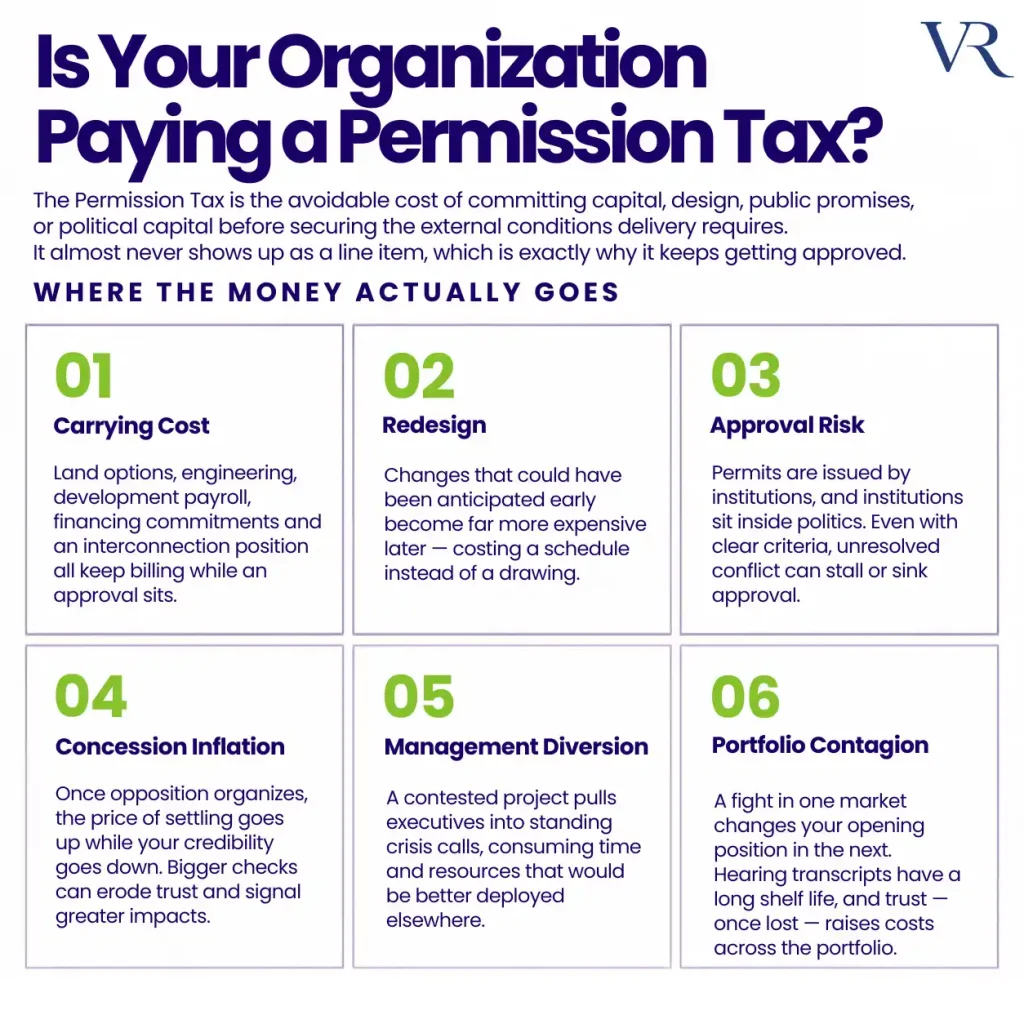
2026 © VantageRoad Partners. Permission Tax: Where doe the money go?
Carrying cost. Land options, engineering, development payroll, financing commitments, and an interconnection position all keep billing while an approval is stuck or pulled back. “A few more months” sounds survivable but when you put the capital at risk next to the monthly burn, investors, rating agencies and the Board are not going to like what they see.
This is where the argument has changed most in the last twelve months, because the capital has shifted from equity to debt. Goldman Sachs Research puts hyperscaler debt financing at roughly 33% of capex in 2026, up from 27% in 2025 and headed to 35% in 2027 (Goldman Sachs), against aggregate 2026 capex for the five largest sponsors approaching $800 billion (Vanguard). And the market is beginning to price the risk: technology spreads sat at 89bp on August 21, roughly 9bp wider than the overall investment grade index, with new issue concessions stretching to 20bp on a very large hyperscaler deal and insurance demand for 30 year AI tranches roughly halving between Q1 and Q2 (Reuters, Goldman Sachs). The 10-year Treasury reached 4.76% on August 31, its highest since January 2025, and the 30-year sat at 5.25% on September 3 (Trading Economics, FRED).
When equity funded the buildout, a two year approval fight was an annoyance. With a third of capex borrowed at 5%+ on the long end, and concessions widening with each return to market, the carrying cost of a stalled project is now a line item that a CFO is paying attention to. The strain is already showing up. Meta’s Q2 free cash flow fell 91% to $784 million, with Zuckerberg publicly framing a capacity allocation trade off (Reuters, CNBC), and S&P downgraded Oracle to BBB- in early July (CNBC). No sponsor has announced an outright pause and that is precisely the window in which permission is cheapest to buy and most valuable to hold.
Redesign. Moving a setback on a concept plan is just changing a drawing. Moving it after procurement, environmental review, stormwater design, and load studies costs a schedule. And the conditions that force the move are usually the ones you could have seen had you engaged the right stakeholders early: a popular McDonald’s location, a school bus route, wetland or waterway impacts, where the water actually goes when it rains, a volunteer fire department’s real response time, the difference between a road on the county map and the road people take to work, and how many turns of a stoplight someone already sits through on that route.
Approval risk. People consistently underweight this because they read the ordinance and assume the ordinance decides. Permits are issued by institutions, and institutions sit inside politics. A commission can have perfectly clear criteria and still be looking at a full room, a threatened lawsuit, and a primary in five months. Show up with unresolved conflict and you are asking a decision maker to eat it for you. Some will. Most won’t. In a fragmented municipal system like Pennsylvania’s, that risk multiplies: local zoning, land development, county conservation district review, DEP permits, utility requirements, and state economic development support all move on different clocks, and any one of them can reset the others.
Concession inflation. This is the part that surprises executives most. Once opposition organizes, the price of settling goes up while the credibility of your offer goes down. The company reaches for a bigger check, because money is the lever that moves fastest in traditional business negotiations. Residents read the bigger check as proof the first number was arbitrary, and trust falls off a cliff. As the check goes up, they read between the lines that the impacts are worse than what was disclosed. Delay starts costing you and paying them. That’s when you’ve lost the negotiation and now that CBAs are becoming a permitting condition rather than a settlement device, you will be signing one from that weakened position regardless.
Management diversion. A contested project pulls the CEO, the GC, the investment committee, public affairs, and comms into standing crisis calls and extracts otherwise better deployed resources. Routine decisions start requiring executive sign off. Nobody models that hour, that day, that week spent on something that could have been addressed sooner.
Portfolio contagion. Advocates, regulators, reporters, lawyers, utilities, and future employees all work across markets. Hearing transcripts, litigation filings, and social media have a long shelf life. A fight in one township changes your opening position on the next site, the next rate case, the next charter application and can shape future tax, rate, or operating policy. Trust is lost, the cost goes up, and the precedent is set.
The power path carries its own permission exposure
There is a version of this buildout where the developer believes it has routed around the whole problem by avoiding it. They think that if they build the generation behind the meter, island the load, and stop asking the grid or the public for anything, they’ve solved the problem. That’s the equivalent of building the addition without pulling the permit. It’s your land, you paid cash, you didn’t ask anybody. And it works. For years it works. Then you go to sell, and the appraiser counts square footage that legally doesn’t exist, the title company wants a certificate nobody can produce, and the buyer’s lender walks. You didn’t avoid the inspection. You deferred it to the moment you had the least leverage and the most at stake.
The premise that self supplied power sits outside conventional permitting is being tested in federal court, at state agencies, and at EPA at the same time (WilmerHale). And a Central Washington plant meant to serve data centers was cancelled after roughly 500 public comments (KUOW) — no interconnection queue required.
Speed is being measured wrong
Most dashboards reward time to announcement, filing, approval, groundbreaking. Those milestones matter, but they reward fragile motion.
The better metric captures a different story: time to durable operation from first commitment to an asset that can operate, expand, and retain support under conditions its owner can actually sustain.
A project that becomes the issue in a local election is not derisked. A permit won 4–3 with litigation forming is not derisked. Each of these erodes trust, especially because they tend to be reduced to a press release with minimal transparency on actual process, terms, and mechanisms.
Speed is pace of motion. Progress is conditions secured. They should not be treated the same way.
Reversal risk is what makes this concrete. Benton County approved, then denied. The Illinois Supreme Court reversed an appellate reversal on Grain Belt Express, 6–0 (OK Energy Today). Federal courts reversed federal stop-work orders on all five paused offshore wind projects in January (Greenberg Traurig). “Approved” is no longer final in either direction. If a decision can be unmade, then the date on your approval is not the date your risk ends, which is the whole argument for measuring time to durable operation instead.
Pennsylvania makes the distinction unusually visible. PJM is pursuing new ways to integrate large loads, including stronger forecasting, bring-your-own new generation pathways, expedited interconnection for associated generation, and arrangements where certain large loads may be dialed back during system stress.[4] At the same time, the Commonwealth now requires GRID commitments and local approvals as conditions for state permitting. “Fast” therefore depends on aligning site, load, generation, transmission, environmental review, local authority, incentives, enforceable commitments, and community legitimacy early enough that one workstream does not invalidate another.
What is permission?
Permission reminds us all of asking the teacher for a hall pass, or asking your parents to stay out past curfew, some form of control and authority. It is a largely foreign concept to entrepreneurs, disruptive industries, and technology leaders, and that spirit of innovation is not something we want to break. But there is a way to turn permission into support and consent, and to make it a trackable, hard metric.
A hearing that normally draws a handful of regulars fills the room, and the sign in sheet is all township addresses, not a regional advocacy group that drove in or recruited a bunch of locals. Local means it’s about your project. Regional means you’ve been adopted into someone else’s campaign. Those are different problems with different solutions, and companies routinely confuse them.
You can tell when you are anticipating the needs of a community and meeting them, and when you are not.
Every stakeholder will be telling you exactly how much room you have, and most of it arrives long before it shows up in a schedule. They are warning signs and inflection points where trust can move in either direction. And you need to be tracking them in a way that allows you to move quickly to address and predict.
Working definition: permission is the accumulated willingness of the stakeholders capable of affecting an outcome to let you proceed.
Accumulated, because it’s built by behaviors over time. One performative check the box town hall doesn’t create it, and one well documented ribbon cutting doesn’t preserve it. Willingness, because compliance isn’t support. People can follow a ruling while organizing to reverse it. Capable, because you should listen broadly but be honest about who holds authority, influence, and standing. Proceed, because permission is specific. People can like your company and hate your site location, accept the technology and reject the cost and burden imposed on them, live with Phase 1 and distrust everything you’ve said about Phase 2. They can take your check and remain actively and vocally opposed.
Getting a permit is the answer to whether it is legal. But permission answers whether the system around it will let it stay in motion and run to finish. You can get a permit and still not have permission, and either one can halt a project.
It is not a communications problem
Comms can explain a tradeoff and show statistics on a project. It can’t repair a bargain that was badly designed at the start or not followed through on. When a company misreads resistance as a messaging challenge, the reflex is to refresh the comms team or hire an outside PR consultant to change the storyline. No messaging strategy will be credible without tangible evidence behind it.
“Local jobs” fails as a narrative when the details are murky on skills, levels, and permanence. Fail to answer how many are permanent, what they pay, who qualifies and you will lose the audience. “No ratepayer impact” fails when cost allocation is unresolved and expected. Even if energy costs going up for the community is attributable to other factors, they will track the prevailing thesis that large load projects are to blame. And in the case of data centers, the physical manifestation of their greatest fear, that AI is changing the needs in the labor market. Maybe not taking their livelihood but making them less valuable over time. “Community investment” fails when nobody can say who controls the money or what happens if it doesn’t arrive. Some companies have tried variations like giving $50,000 to teachers, creating a six week apprenticeship to train people for AI infrastructure jobs. It’s a great press release, but without scale, ownership, funding, eligibility, and outcome measures, it fails to mobilize a community of passion in either direction. And sometimes can have the opposite effect with a stakeholder set.
The objective is not to achieve consensus. High impact projects change places, and even reasonable people will oppose them. People don’t like change even when the upside is significant, because disruption is immediate, personal, and uncomfortable. What projects should be seeking is legitimized sufficiency: enough informed support, institutional confidence, and procedural fairness to survive predictable opposition.
That requires evaluating which objections are legitimate and should change the project, which can be accommodated, which just need to be heard and given a straight answer, which will never be resolved, and which are alarm bells about a fatal flaw. Teams that can’t sort tend to fail in one of two directions: they redesign forever to win support that was never available, or they dismiss every critic and erode the trust they still had.
It builds in order
Companies routinely try to buy a community’s permission before they’ve earned the credibility to make it believable.
- Standing: Know the place well enough that the place will listen to you.
- Credibility: Make claims that survivescrutiny, andbe honest about tradeoffs.
- Compact: Be specific about who does what, howit’sfunded, when it’s done, measured against what, with what remedy if you miss.
- Stewardship: Maintain the relationships and the commitments through construction, operation, growth, and every leadership change on both sides.
- Advocacy: Not speaking with your own voice. People with no stake in your payroll explaining why this deserves support, in their own words. And that last partcan’tbe transactional.
Once you earn it, you have to keep investing. One broken promise can take out years of credibility. Warren Buffett famously told a Berkshire meeting, “It takes 20 years to build a reputation and five minutes to ruin it. If you think about that, you’ll do things differently.”
New ownership, an expansion, a political transition, a rate increase, a missed hiring commitment, or a change in operating conditions can send you back to earning it. But so can skipping the steps to truly invest in a community early and often.
The Trust Gap, and one discipline
The most useful definition of authenticity is the distance between what you say and what you can deliver.
“Local jobs,” while your workforce plan imports crews. “No ratepayer impact,” before cost allocation is decided. “Community partnership,” announced after the site, the design, and the benefits package were already locked.
Every one of those will clear legal review but still create risk. So before a significant public commitment goes out, someone should be able to answer six questions on one page:
- What fact supports this claim?
- Which executive owns delivery?
- When does it become true?
- Who’s most likely to challenge it, and on what basis?
- What evidence goes public?
- What’s the remedy if we don’t deliver?
If those answers don’t exist, you haven’t made a commitment. You’ve made an aspiration and put a logo on it.
Which is why every investment memo for a high-impact project should carry a Permission Tax analysis next to construction, financing, and regulatory risk. The cost of delay. The point where decisions become irreversible. The actual basis for assuming acceptance. And what a fight here does to the next deal. Not to forecast politics or assign a number to trust — just to stop treating permission failure as a non-factor.
The window for treating this as optional is closing on its own. States are writing the community bargain into the permit. Turbine slots are dated, prepaid, and repricing. A third of the capital is borrowed at rates that make a stalled schedule legible to a CFO. And 71% of the country does not want the thing you are building anywhere near them.
Just like reading a balance sheet and evaluating the culture when you look at an acquisition, diligence on a project should include asking the question: What would we want to know before this gets expensive to learn?
Notes
[1] Amazon announcement of at least $20 billion in Pennsylvania cloud and AI campus investment, 2025, beginning in Luzerne and Bucks Counties.
[2] Commonwealth of Pennsylvania, Governor’s Responsible Infrastructure Development (GRID) framework, May 2026.
[3] Executive Order of August 18, 2026, establishing GRID Requirements as binding conditions on Commonwealth permits for data-center development, including DEP sequencing behind local approvals, removal of AI data-center eligibility for PA Permit Fast Track, and the GRID consent-order pathway.
[4] PJM Interconnection, large-load integration proposals, including load forecasting reform, bring-your-own-generation pathways, expedited interconnection for associated generation, and curtailable large-load arrangements.
[5] Pennsylvania DEP public informational meeting, Project Gravity data center, Lackawanna County.