


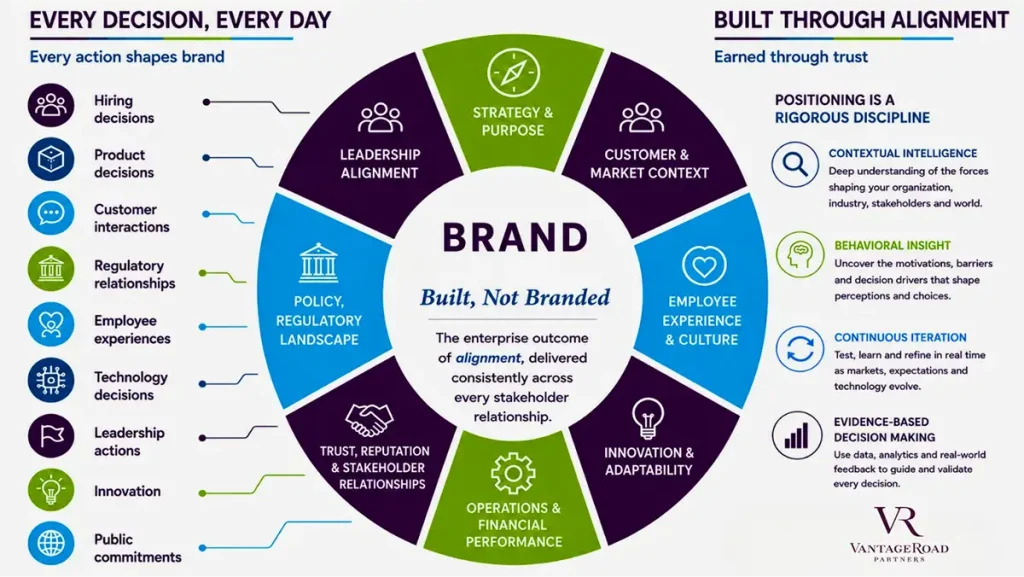
For decades, organizations have approached brand as a communications or creative challenge. More so, many boards and c-suite leaders think it is “branding” that needs to be fixed. For the sake of definition, think brand equals business, or a brand is the collective perception created by everything stakeholders see, hear, and experience.
When growth slows, competitors gain momentum, employee engagement declines, or customers become confused. The conversation that ensues often leads to the same conclusion: “We need a rebrand.”
It is an understandable response. For years, managing a brand followed a familiar sequence: research the market, analyze competitors, define a position, develop messaging, design a visual identity, and launch the campaign. That methodology shaped generations of successful brands, and it reflected the business environment of its time.
Today’s business operating environment bears little resemblance to the one in which those methodologies were created. Organizations now compete in a world defined by algorithmic discovery, geopolitical uncertainty, economic volatility, regulatory complexity, cultural polarization, stakeholder activism, and unprecedented transparency.
Customers no longer passively receive brand messages; they investigate them. Employees shape reputation as much as external advertising. Investors assess credibility alongside financial performance. Regulators influence market access. Communities grant or withhold the social license to operate. Increasingly, AI systems become the first interpreter of an organization’s identity, synthesizing thousands of signals into a digital reputation that no marketing campaign can fully control.
In this environment, the question is no longer, “How do we build stronger branding?”
The more important question is, “What kind of organization are we building to manifest the brand we want to be”?
That distinction changes everything.
Branding and brand development are not the same discipline.
Brand is the outcome. Branding is the expression. Brand development is the discipline of aligning strategy, leadership, culture, operations, innovation, employee experience, customer experience, and stakeholder relationships so they create a clear, credible, and differentiated perception among stakeholders.
One expresses. The other builds. This shift is not simply an observation; it is increasingly supported by academic research.
Studies published in the Journal of Brand Management conclude that organizations no longer own their brands in the traditional sense. Brand journeys now occur simultaneously across physical, digital, and virtual environments, where customers, employees, online communities, influencers, and user-generated content continuously shape meaning alongside the organization itself. In other words, organizations no longer dictate the brand’s narrative. They participate in it.
That insight fundamentally changes the role of leadership.
Rather than attempting to control perception, organizations must build the internal alignment and operational consistency that allow trust to emerge naturally across every touchpoint and with every audience, not just buyers. Brand becomes less about managing communications and more about managing the enterprise.
Developing a brand in the reputation economy.
Large organizations once enjoyed a significant advantage because they controlled advertising budgets, media relationships, and access to mass communication. Today, that advantage has largely disappeared. Research from the Wharton School describes the emergence of what many now call the reputation economy, where influence has shifted toward customers, employees, creators, analysts, online communities, and digital platforms. Reputation is no longer built through one-way communication. It is earned through thousands of interactions that either reinforce or contradict what an organization claims to represent.
Every business decision contributes to the brand.
When the right insights are brought to the table, misalignment happens when the opinion machine starts, the blockers silently rewarded, and the executive sponsor wants 100 PowerPoints. That is not going to build an enduring brand. Brand equals business and internal and external trust earn the permission to grow.

Brand strategy & planning are critical to longer term corporate strategy and business execution efforts
Brand building means unity is critical across:
- Hiring decisions
- Product decisions
- Customer interaction
- Regulatory relationships
- Employee experience
- Leadership actions
- Innovation
- Community and public commitment.
The discipline itself has evolved as well
Research published in the Journal of Product & Brand Management documents the progression of brand management from a communications function to a strategic business capability. Leading practitioners increasingly argue that positioning has become a far more rigorous discipline, requiring contextual intelligence, behavioral insight, continuous iteration, and evidence-based decision making. Success depends less on creating compelling messages than on discovering positions that organizations can authentically own and consistently deliver.
This explains why so many organizations invest heavily in new positioning, refreshed messaging, or visual identity, yet continue to struggle with trust, differentiation, or sustainable growth.
The problem is rarely the communications. It is the alignment behind them.
Brand value is no longer created by marketing alone. It is created by reducing friction across the enterprise. Every gap between strategy and execution, leadership and employees, promise and experience, innovation and adoption, or policy and public expectation weakens trust. Every point of alignment compounds it.
That alignment has become increasingly important because the consequences of misalignment have never been greater. Goran Paun, Creative Director at ArtVersion wrote in Inc., in an article titled, One Team No Longer Owns Brand Experience, that organizational alignment turns brand thinking into a connected system.
Ironically, many organizations still treat messaging as the starting point. Research suggests that a significant number of companies develop positioning and communications without directly engaging customers first, creating a disconnect between what organizations want to say and what their markets actually need to hear.
These are not simply marketing misses. They are alignment failures between internal and external realities.
As brand strategist Steven Silverman, Ph.D. observed, in a Linkedin post, “Brand strategy cannot be treated as a linear process that ends with a campaign. It must be treated as a system of meaning shaped by interconnected decisions”.
This observation captures the challenge facing executive teams today. Brand weakens when strategy, operations, leadership, culture, customer experience, innovation, public affairs, and stakeholder expectations begin moving in different directions.
Modern brand development therefore begins somewhere entirely different. It begins with context.
It is understanding the forces shaping the organization before asking how the organization should position itself.
Those forces include business strategy, North Star direction, leadership alignment, employee experience, customer psychology, hidden buying motivations, technology and AI, innovation, economic conditions, policy and regulatory realities, geopolitical shifts, market dynamics, societal expectations, community trust, financial performance, brand equity, and operational consistency.
Red alert! None of these sit outside the brand. Together, they create it.
The organizations creating enduring brands over the next decade will not necessarily produce better campaigns or more memorable taglines. They will build organizations whose strategy aligns with their culture and all stakeholders. They will understand that brand is not a team in a department – it is an executive leadership accountability.
If you are a c-suite leader, running organizational strategic planning or a board director addressing growth with a stalled brand, dealing with reputation risk and trust building, here are three areas to explore that are part of a bigger playbook and roadmap:
Misalignment usually begins when different parts of the organization are working toward different priorities.
- Leadership should ensure everyone can answer the same questions:
- Where are we going?
- Why does it matter?
- What decisions will we make differently because of this strategy?
- What are our top business priorities now, and over the next 3-5 years?
- Are we having the right conversations to address internal and external realities?
Brand impact: Customers, investors, employees and partners experience a company that feels focused, consistent and trustworthy instead of fragmented.
- Align leadership behaviors before communications
Culture follows what leaders do, not what they say in endless rounds of PowerPoints. Before launching a new strategy, purpose statement or positioning refresh, leadership should ask:
- Are incentives aligned across all stakeholders and is the priority clear they all need to be considered?
- Are we developing strategy is a silo – who else should be at the table?
- Are decisions reinforcing stated priorities?
- Are leaders communicating consistently with meaning and associate actions?
- Are we modeling the behaviors we expect?
If executives send mixed signals, the organization amplifies the inconsistency.
Brand impact: Employees and other stakeholders become credible ambassadors because the internal experience matches the external promise.
- Measure alignment continuously—not just performance
Most organizations measure financial results and operational KPIs but rarely measure alignment. Leaders should regularly assess:
- Strategic understanding
- Decision consistency
- Cross-functional collaboration
- Stakeholder trust
- Customer and employee experience
- Areas where priorities conflict
Misalignment is much less expensive to correct early than after it shows up as declining trust, turnover, customer dissatisfaction or reputation issues.
Brand impact: The brand becomes stronger because it is reinforced through everyday decisions rather than marketing campaigns alone.
A final poignant note to underscore this article.
Marissa Jarratt, former CMO & EVP for 7-Eleven, and Founder of Jarranova says, “Too many organizations treat brand as a communications problem when it is fundamentally an alignment problem: the disconnect between what they aspire to stand for and how the organization actually shows up across every decision, relationship, and touchpoint. What VantageRoad Partners articulates here is what the best boards and executive teams are beginning to understand: brand is not a department’s responsibility. It is a leadership accountability. And the organizations that internalize that will be the ones that earn durable trust, and with it, the permission to grow.”
At VantageRoad Partners, we believe this represents a fundamental evolution in the discipline itself. Brand development is no longer a linear sequence of discovery, positioning, messaging, design, and activation.
The strongest brands of the future will not simply be branded. They will be built through informed alignment.